
Can a Bookshop Shape a Life? Closing a Musical Chapter at London's Travis & Emery Bookshop
A final pilgrimage in May to London's musical treasury Travis & Emery brought me back to the heady days of navigating away from my stable 9-5 job to embark on a much more precarious path...


Last month’s final pilgrimage to Cecil Court brought me back to a pivotal time in my life. On 21st May Travis & Emery, specialising in second-hand and antiquarian music books and scores, closed its doors in central London after 60 years*. Over the past decades, the bookshop became a gentle source of inspiration as I navigated away from my stable 9 - 5 job, and embarked on an altogether more precarious path…
“…they have everything in there…”
I remember my first visit to Travis & Emery back in 2003. In search of more affordable scores, I had been prompted by one of my fellow part-time conducting students at Morley College to check it out. “It’s a musical treasure trove - they have everything in there: books, all kinds of sheet music…and loads of scores!”
And so I found myself, on a lovely October evening, in front of the green Travis & Emery shopfront.
Although I had already lived in London for a few years, I hadn’t noticed Cecil Court, once a temporary home (in 1764) to a precocious young Mozart. The pedestrianised lane is a wonderful enclave of curiosity, situated off St. Martin’s Lane, in the heart of London’s West End, mere steps from Leicester Square.
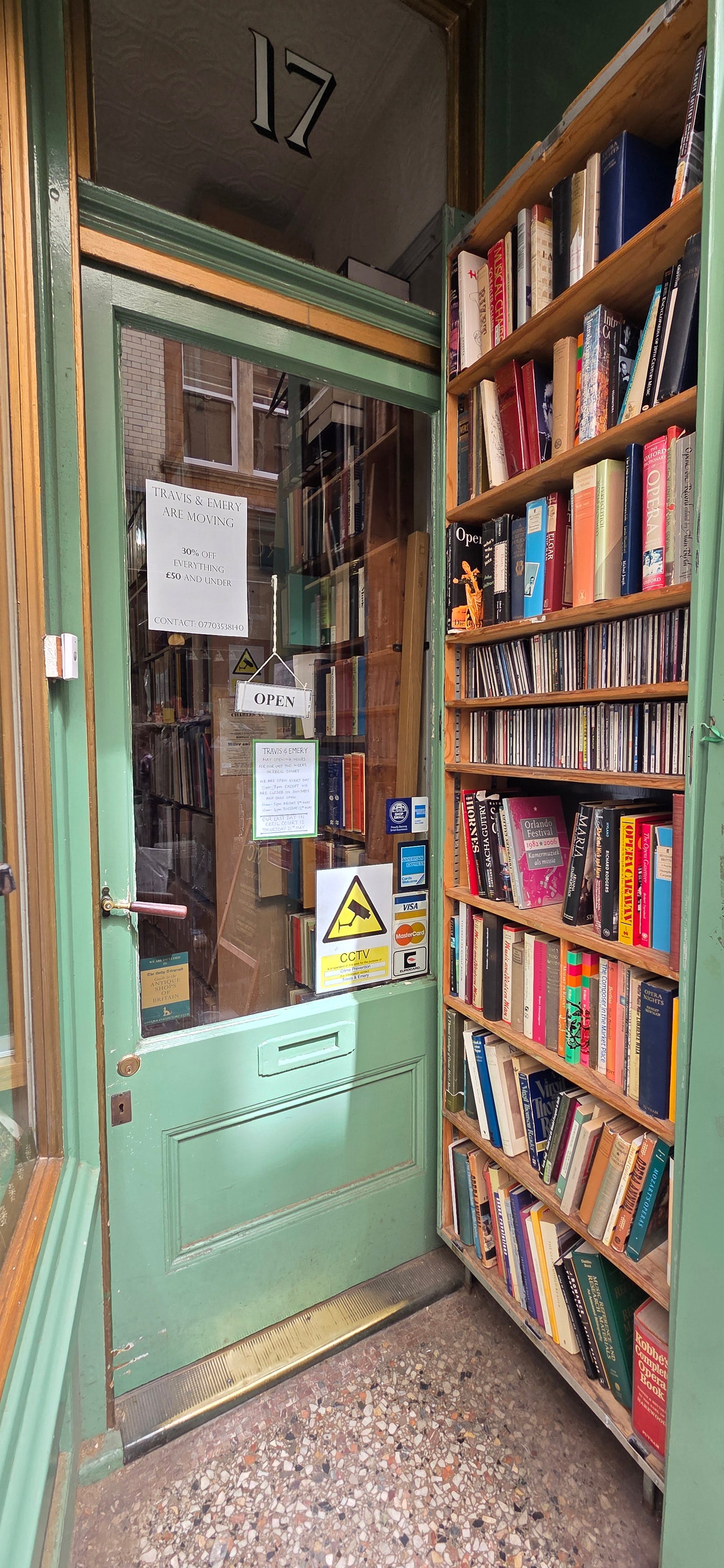
From outside, on that first visit, Travis & Emery seemed intimidating, with some fairly expensive looking scores featured in the beautifully arranged window display. But I had come this far, so I ventured in, and a decades long journey of discovery began!
So many possibilities…
Inside, every usable inch was filled. There was just about enough space to browse—punctuated by inevitable muttered apologies to fellow explorers as we edged awkwardly past one other!
The shelves were stacked, almost to overload, with composer and musician biographies, books on music, music theory, music history, opera, sheet music from every era… and scores…so many, many scores.
A full bookcase of Eulenburg miniature scores, multistories of full scores—opera scores, Dover scores, oversize scores. Scores to take me through multiple lifetimes.
There would NEVER be enough time to learn them all. But there they were, all waiting to be discovered.
A deepening obsession…
In those early days I was obsessed with discovering everything possible about orchestral repertoire, conducting and conductors.
I had just started a part-time conducting course at Morley College which involved weekly Friday evening sessions on theory/conducting basics, and then a Saturday afternoon conductor’s orchestra to try it all out (and play violin while not conducting!).
At the time, I was working full-time as a structural engineer for a boutique London firm, specialising in structural steel design and collaborating with some cutting edge architects. The work was creative in its way, but the conducting bug had bitten badly and I felt inexorably drawn to this mysterious world of orchestral music…
Each visit to Travis & Emery brought me deeper.
It was here I bought my first biographies of Karajan and Bernstein, my first miniature scores of Haydn string quartets (for score reading practice), reduced price Dover scores of the Beethoven symphonies (I didn’t know much in those days about editions!), my first vocal scores of Handel’s Messiah and Mozart’s Figaro… music that I have studied, played and conducted in the years since.


Pages with a history…
But the books and scores were more than musical possibilities. They were a portal into a world I wasn’t yet part of. These pages had all been owned before, had all been in other hands, on other music stands, on other bookshelves, read by the eyes of people I would never meet.
Occasionally the title page of a score would feature a carefully inked name, added by the previous owner. Internet searches would rarely yield a result for these musicians, unknown, perhaps, outside their own circles, but scattered in towns and villages up and down the country. Enraptured by an art form that spans time and place, they occupied a disappearing analogue world, their musical spirits somehow entwined with the books I now perused.
Over time, the shop itself became a character in my life. I was intoxicated by that unique smell—you know the one: not-quite-musty paper laced with possibility—the promise of riches patiently waiting to come to life off the page!
The shop’s customers too were fascinating, ranging from newbie students (like myself!) to seasoned experts, who would engage the staff in detailed conversations, casually dropping names of classical luminaries past and present with whom they had performed/worked.
Travis & Emery felt like a welcoming haven in the heart of London, a chance to be immersed in the stuff of the art form, in the company of kindred souls.
A radical decision…
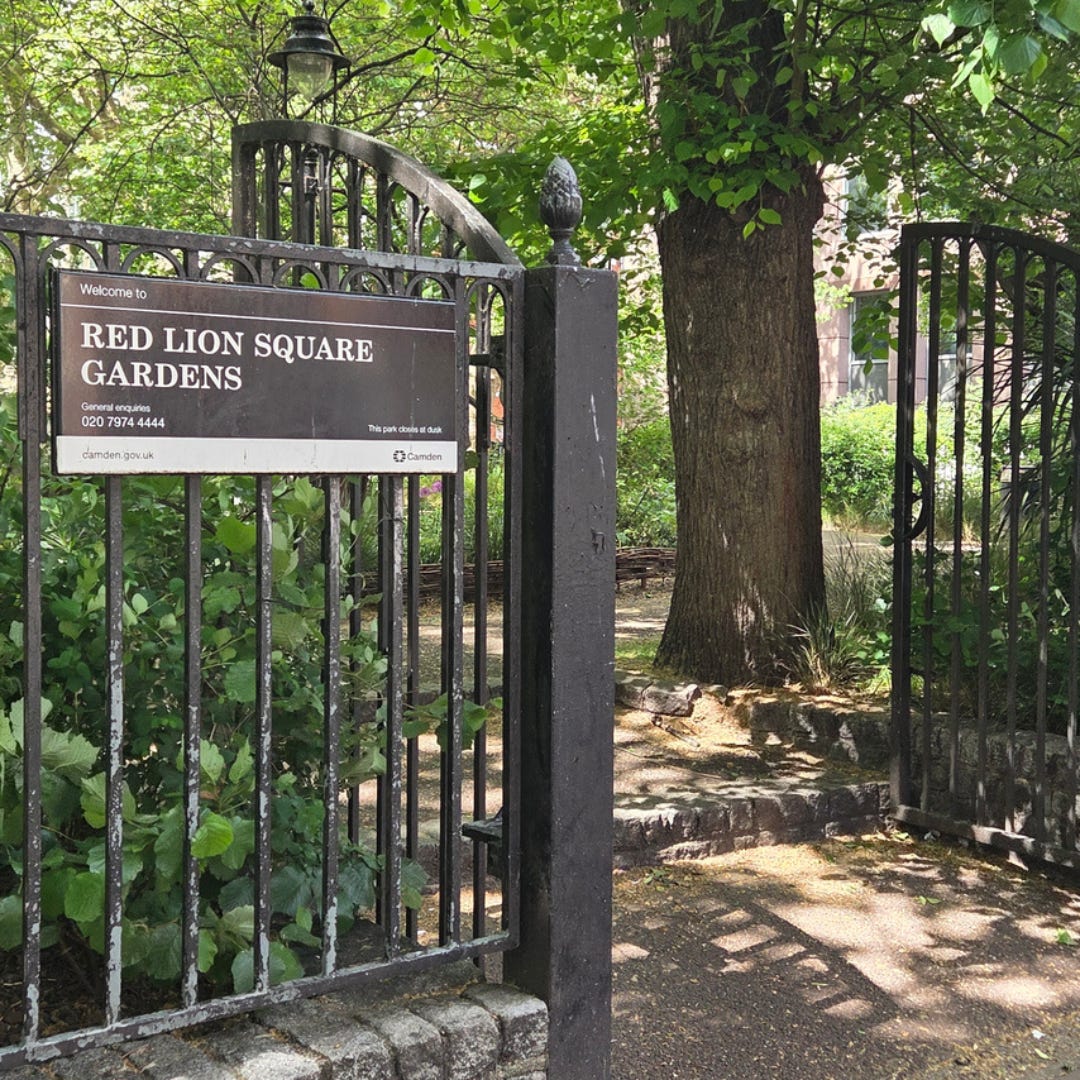
Last month’s nostalgic pilgrimage, a one-day hop from Dublin across to London, brought back so many memories. Retracing my steps from my old engineering office near Chancery Lane towards Travis & Emery, I wandered into Red Lion Square.
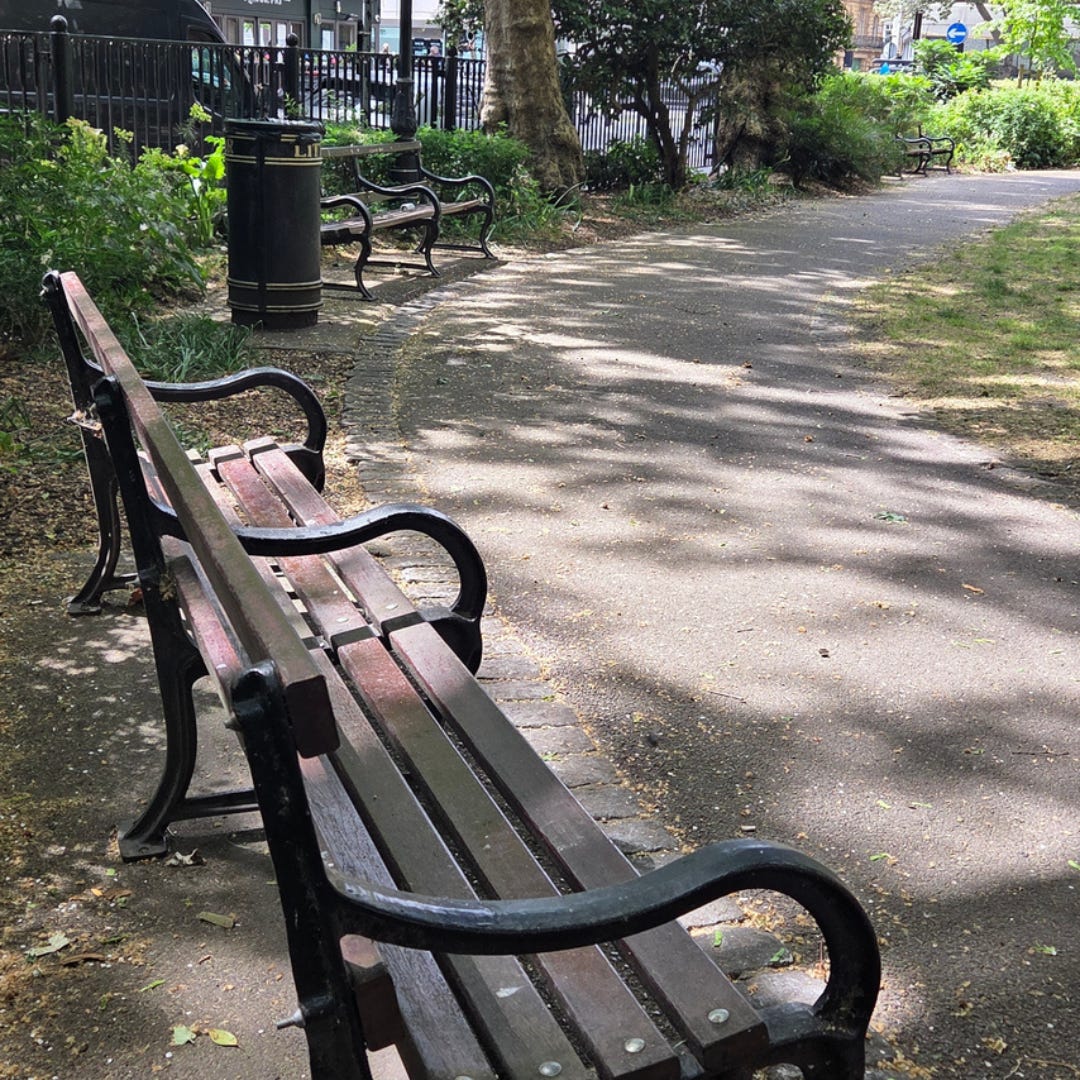
It was here on these benches, during one of many lunchtimes spent reading about the exotic world of orchestras and conducting, that I finally made one of the biggest decisions of my life: to give my final notice at my engineering job and go all-in on this conducting obsession! The Morley College conducting course had finished, and the void was unbearable.
The plan?
Step 1: Embark on a music degree in violin and composition (while working part-time—as an engineer as it turned out!)
Step 2: Do a masters in conducting.
Step 3: Somehow become a professional conductor!
Simple!
Linear…
It was NOT Linear!
I did follow through with the plan, and somehow navigated to here: a fulfilling freelance conducting (and musical) life that has brought me to work with some truly amazing orchestras and groups, on some of the world’s most profound musical masterpieces, while meeting fabulous humans along the way.
My engineering experience definitely helped with so many aspects of this new musical life, not least the creative problem solving skills that translated seamlessly to the podium as I navigated scores of ever increasing complexity! But I haven’t engaged in any professional engineering for almost two decades now. My sister lectures in structural engineering, after a very successful (and longer!) career in industry, so we occasionally have conversations around scheme and first principles design…it keeps the old engineering synapses firing!
But since those early days of excited discovery, I have come to realise that it wasn’t really conducting that I fell in love with, it was the music itself. Conducting was just a gateway to this rich and deep world of inspiration. There are always new depths to plumb: whether it is diving deep into a composer’s story to uncover some creative context that brings a piece to life, or revisiting a familiar score at different stages of my life.
I still use paper scores for conducting, despite succumbing to the lure of the iPad for a couple of years. Marking up the virtual pages just wasn’t the same, and one too many slips of the finger, with a couple of near disasters (one contemporary opera springs to mind!), sent me gratefully back to the analogue world of paper, pencil and the joy of being able to see a full page ahead!!
But such experiences are all part of the process, and learning to lean into that process, to the joy of the music itself, while somehow filtering out the noise, naysayers and technological blips… well, that has turned out to be the real key to a fulfilling musical life!
The strange comfort of the unknown…
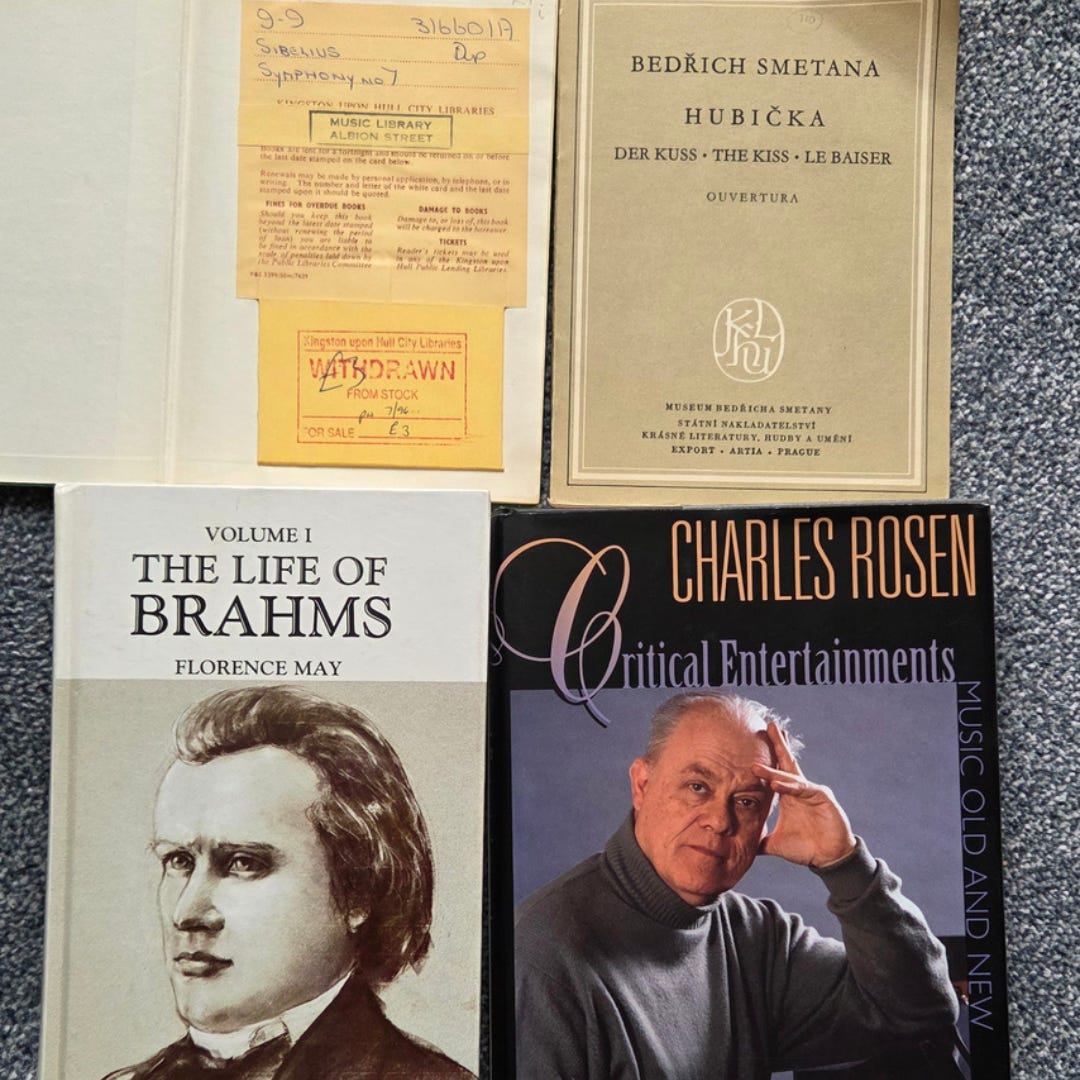
Last month, as I walked through the door of Travis & Emery for the last time, I felt like I was saying goodbye to an old friend, one who had gently shaped my life over two formative decades. My final haul (pictured above) was typically eclectic.
There was something inherently accessible about the shop. Here was this wonderful world, access to which is gatekept for participation at the highest levels, somehow all there for the discovering. I couldn’t see the barriers back then, just the possibilities.
I will miss the flights of fancy as an obscure score triggers a fantasy programme built on the most ephemeral of themes (Smetana’s The Kiss overture for a Valentines night concert that somehow also shoehorns in Sibelius Symphony No. 7??).
Or the title of a book that exposes a previously unknown knowledge gap: Three Centuries of Harpsichord Making anyone?? Absolutely 100% YES, but just not today!
I will miss that feeling of excited overwhelm, as the shelves remind me of the vastness of this artform. But there is a kind of comfort in the vastness…
Mostly though, I will miss the person I was in those early days, an engineer who had always vowed to return to music, so excited to have uncovered a hidden talent as a conductor, and obsessed with discovering everything possible about this fathomless world of orchestral music!
She believed that anything was possible, and in some ways she was right…in some ways…
The books and scores from Travis & Emery fuelled that belief, gently shaping and kindling a lifelong passion for this wondrous artform. For this, and everything I have had a chance to discover since, I am profoundly grateful.
* Postscript: Although they have closed their wonderful Cecil Court shop, Travis & Emery are very much still trading online.
https://www.travis-and-emery.com/
Welcome
A warm Irish céad míle fáilte to all the new subscribers to the blog. I’m delighted you have decided to join me on this circuitous meander. I hope to meet you over the coming years in the real or the virtual world!
In memoriam…
So many artists have left us in the past months…
I was sad to hear of the passing of Dame Felicity Lott (Flott). Her incredible artistry and good humour have been a constant inspiration over the years.
Michael Tilson Thomas was a trailblazer whose unique gifts as a conductor and communicator, allied with razor sharp intelligence, redefined what a conductor could be for me.
Günter Pichler was a musician who, through his finely tuned instincts, seemed to be communicating directly with the composer, and bringing their music in its purest, most unaffected form to our ears. His recordings with the Alban Berg Quartet are my absolute go-to references. Although I never met him, I am so grateful for the legacy he left behind for us all.
Summer Teaching Studio
I am looking forward to my summer teaching studio. I have a few slots open for conductors, violinists and composers in person and online June and July. If you’d like to book a free consultation Zoom (20mins) to see how we could work together, the link is below. More information is on my website!